Manage roles
You need the admin rights to use this feature.
To help you get a better understanding of role management, the following list shows the relationship between users and roles:
- Roles define what actions a user can perform by grouping privileges.
- Users can have multiple roles, enabling flexible access control.
- Roles are reusable and can be assigned to multiple users.
KAIZEN offers some predefined roles that can be assigned to users, such as Project Manager, Developer, UI Designer, External Viewer and so on. Each role is tailored with specific access levels, enabling precise control over features and functionalities for managing both applications and the overall project.
| Subject Type | Role Name | Description |
|---|---|---|
| Project | Project Manager | See this table for more details |
| Maintainer | ||
| Application | Application Leader | See this table for more details |
| Application Manager | ||
| Developer | ||
| UI Designer | ||
| Internal Viewer | ||
| External Viewer |
Subject definition and example
Subject provides a contextual layer within the RBAC model by defining the scope in which roles and privileges apply. This enables fine-grained access control by allowing roles and privileges to be configured and grouped according to specific functional areas or modules, ensuring that permissions are applied only within the relevant subject context to meet unique business requirements.
For example, in KAIZEN App Designer, we have roles and privileges for Application level. The Application Manager of the application can assign members to access the application.
How a Subject works
We can use Subject to add RBAC control to the data level. In a Recruitment Management system, we can use Subject to control the access rights for each job application.
Imagine a recruitment system where different individuals take on roles such as Hiring Manager, HR, and Job Applicant. Each role comes with specific privileges, but access to the job applications should be restricted based on assignment.
- Admin users may oversee job application management but should not influence any outcomes of the hiring process.
- Job Applicants should only access the job applications they are submitting, but they cannot assign Hiring Managers.
- Hiring Managers should have full decision-making privileges over the job applications they are assigned to, but they cannot access or modify job applications they are not involved in.
In this scenario, the job application itself acts as the Subject. A hiring manager is not simply assigned a role, they are assigned a role in relation to a specific application.
An example of assigning job applications to hiring managers
Consider Hiring ManagerAlice and Hiring ManagerBob. They are having the same role, but their privileges are scoped to the job applications they review.
- Alice is assigned with Hiring Manager role to Job Application #1001. She can review applicant information, download resume, and set interviews.
- Bob is assigned with Hiring Manager role to Job Application #1002. He has similar privileges but only within the context of the job openings he provides.
- Neither Alice nor Bob can interfere in each other's recruitment, even though both are Hiring Managers.
This fine-grained control is achieved by defining the job application as a Subject, ensuring that privileges are only valid within the assigned scope.
Manage the roles
To manage the roles, perform the following:
-
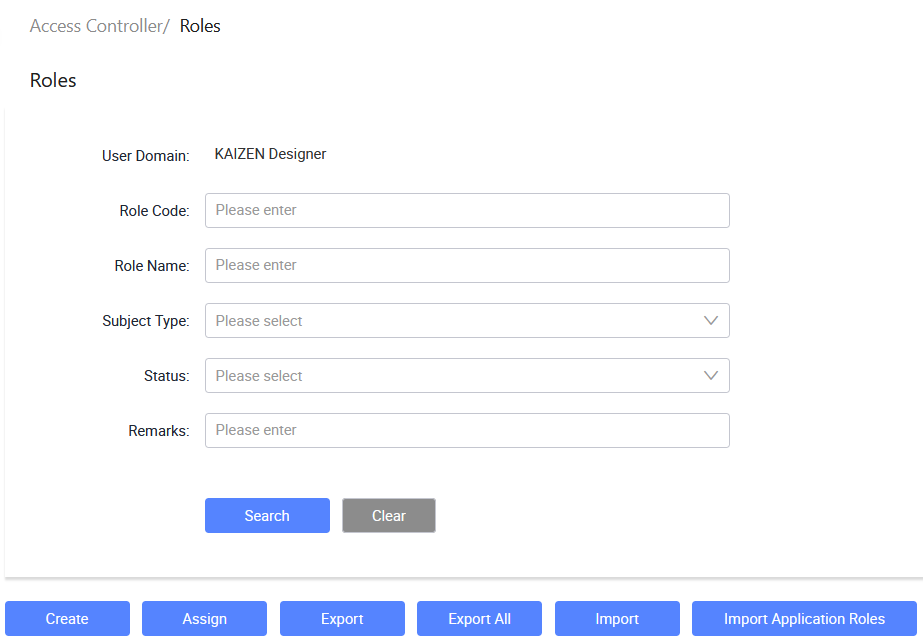
In the KAIZEN studio console, on the left panel, click Access Controller > Roles.
The Access Controller/ Roles page displays.
-
From here, you can create new roles, import or export roles, assign privileges to a role, and so on.
Create a new role
-
In Access Controller/ Roles, click Create.
-
In the Create Role window, enter the role information in these fields and click Save.
Last updated on 20 May 2026