Conclusion and summary
Congratulations on completing the KAIZEN Express Training Guide. Throughout this inspection tour, you did not have to write dry boilerplate configurations or build basic forms from scratch. Instead, you peeked behind the curtain of a fully operational, high-performance enterprise scholarship application to see how KAIZEN structures visual design, automated process logic, and professional-grade pro-code implementation.
Recap of Your Tour
Let's review the critical capabilities you inspected across each design dimension:
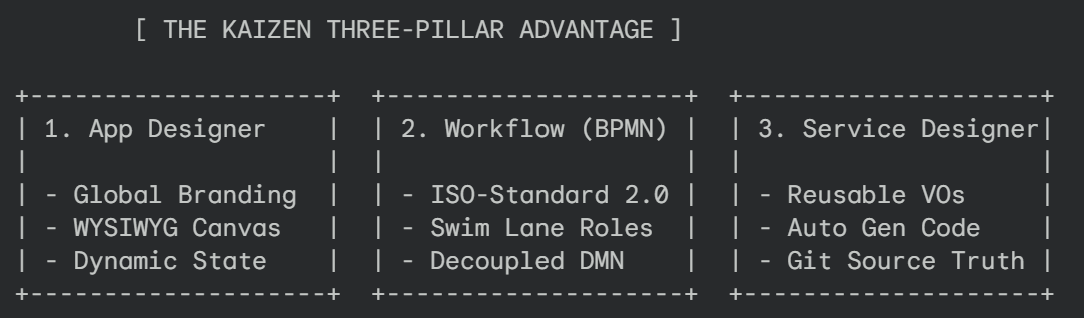
Pillar 1. High-Velocity User Experiences (App Designer)
- What you explored: Global themes (
@tecq/default-blue), responsive viewport testing, and the interactive drag-and-drop Component Library. - Key Takeaway: By binding form cards to single state variables (
this.formField) and using the client-side Next.Field API, developers achieve 100% control over dynamic page states, calculations, and modal prompts without writing manual browser DOM selector boilerplate.
Pillar 2. Standardised Process Automation (Workflow Designer)
-
What you explored: Visual swim lanes separating Students, Systems, and Staff, dynamic routing gateways, and visual Decision Tables (DMN).
-
Key Takeaway: Because KAIZEN utilises the ISO-standard BPMN 2.0 execution language, your business diagrams are not mere drawings; they are the actual running backend orchestrations. Complex logic is cleanly decoupled from raw code using DMN tables, allowing business analysts to make rule changes in seconds.
Pillar 3. Professional Developer Extensibility (Service Designer)
-
What you explored: Microservice controllers, parameterised Value Objects (
ScholarshipVO), and fully structured Spring Boot Java interfaces. -
Key Takeaway: Instead of forcing developers into a proprietary environment, Git remains the absolute single source of truth. KAIZEN generates clean MVC boilerplate structures while preserving custom developer implementation logic (like
ScholarshipServiceImpl.java) and package configurations (usingpom-customize.xmlandapplication-customize.properties).
Aligning with Your Proof of Value (PoV) Criteria
As you transition from this guided tour to your formal evaluation decisions, evaluate how KAIZEN addresses your team's operational needs:
-
Development Velocity (10x Speed): Can your business analysts and frontend engineers prototype fully responsive form applications and update business decision rules visually, bypassing backend backlogs?
-
Maintenance Simplicity: Do centralised themes, reusable Value Objects (ScholarshipVO), and visual datasource mappings make maintaining complex applications cleaner and more structured over time?
-
No Vendor Lock-in: Does the auto-generated Spring Boot Java/React codebase ensure that your organisation fully owns its application IP?
-
Developer Adoption: Can your professional software engineers continue utilising their preferred local IDEs (like VS Code or IntelliJ) and standard Git repository hooks to write high-performance custom business logic?
Thank you for choosing KAIZEN to accelerate and scale your enterprise application delivery pipeline.
Last updated on 21 Sep 2026